
Refrigeration & HVAC
Refrigeration & HVAC Gaskets / Plates
Get the Right Gasket, Right Plate, Right Now – Your Trusted Source for Heat Exchanger Parts.
Refrigeration & HVAC Heat Exchanger Solutions
Overview & Key Applications
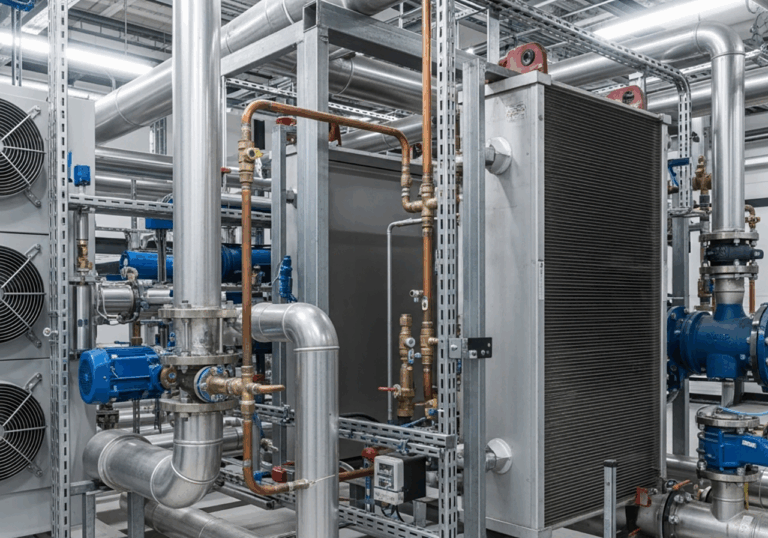
Plate-and-frame heat exchangers (PHEs) are an essential solution for modern HVAC and refrigeration systems, used everywhere from high-rise building chillers to industrial cold storage and district energy plants. Common applications include:
- Chilled water and condenser water loops for efficient building cooling
- Hydronic heating/cooling for zone isolation and energy recovery
- District heating and cooling interfaces
- Data center cooling with clean secondary loops
- Refrigeration plant heat recovery (e.g., using compressor waste heat)
- Separation of fluids in ammonia, glycol, or brine systems
A gasketed plate heat exchanger is chosen for its high thermal efficiency, space-saving design, and ease of maintenance. They help contractors reduce downtime and make it easier to service critical HVAC and refrigeration infrastructure.
Plate Materials & Hygienic Design
In HVAC and refrigeration settings, most heat exchanger gasket plates are made from 316 stainless steel for its excellent corrosion resistance in treated water and most glycols. In harsher environments—such as with seawater or aggressive brines—titanium plates may be specified. Plate packs are engineered for efficient heat transfer while minimizing fouling and allowing for easy cleaning.
While strict hygienic standards are less of a concern than in food or pharma, a smooth, crevice-free plate surface still helps prevent scale and biofilm buildup, extending equipment life and maintaining system efficiency.
Gasketed Plate and Frame Heat Exchanger Material Guide
Picking the right gasket is all about matching temperature, chemical exposure, and cleanability:
EPDM:
(Ethylene Propylene Diene Monomer)
The standard choice for most chilled water, hot water, and glycol applications. EPDM is resistant to hot/cold water, steam, glycol, and most water treatment chemicals. It operates from roughly -15°C to 110–150°C but is not suitable for oil-based fluids.
NBR
(Nitrile Butadiene Rubber)
Used where oil compatibility is needed (oil coolers, compressor lubricant risk). NBR handles water, glycol, and oil, but isn’t ideal for high-temp steam or oxidizers.
FKM/Viton:
Chosen for high-temperature or aggressive chemical circuits (some heat recovery or refrigerant loops), withstanding up to 180–200°C.
HNBR
For best results, always check the manufacturer’s chemical compatibility guides—especially when using glycol blends, inhibitors, or specialty cleaning chemicals.
Top Manufacturers & Models
When it comes to spares availability and service backing, these brands lead the pack:
Alfa Laval:
Tranter:
Kelvion (GEA):
Danfoss (SONDEX):
Xylem (Bell & Gossett / Standard Xchange):
FUNKE, API Schmidt-Bretten, Barriquand:
Refrigeration & HVAC Gaskets and Plates
| Manufacturer | Popular Models | Typical Gasket Materials |
|---|---|---|
| Alfa Laval | M Series M6, M10, M15, M30, MX25, AQ4 | NBR, EPDM, & High Temp & Neoprene |
| Alfa Laval | Semi Welded Series xxBW, xxW | NBR, EPDM, & High Temp & Neoprene |
| API Schmidt-Breton | Sigma Series SX13, SX19, SX29, SX48, SX49, S66, S36, S19, S96, S108, SX35, S106, SX25, SX66 | NBR, EPDM, & High Temp & Neoprene |
| GEA | NT350, NT500, VT2508 | NBR, EPDM, & High Temp & Neoprene |
| ITT Bell & Gossett | PF Series | NBR, EPDM, & High Temp & Neoprene |
| Sondex | S100, S41, S35 | NBR, EPDM, & High Temp & Neoprene |
| Taco | FP Series FP206, FP70, and PF70, FP10, PF100, PF205, FP50, PF022 | NBR, EPDM, & High Temp & Neoprene |
| Taco | TPX Series TPX151, TP20, TPX137, TPX87, TPX167, TPX257 | NBR, EPDM, & High Temp & Neoprene |
| Tranter | UX Series | NBR, EPDM, & High Temp & Neoprene |
| Vicarb | V13, V28, V45, V85, V100 | NBR, EPDM, & High Temp & Neoprene |
| Viex | VX13, VX20, VX45, VX48 | NBR, EPDM, & High Temp & Neoprene |
Frequently Asked Questions
In the Refrigeration & HVAC industry, plate-and-frame heat exchangers (PHEs) are widely used for efficient heat transfer in various heating, cooling, and refrigeration processes. They play critical roles in applications such as district heating and cooling systems, commercial HVAC installations, refrigeration circuits, chiller systems, cooling towers, and heat recovery setups. PHEs efficiently manage thermal loads by transferring heat between fluids like water, glycol mixtures, refrigerants, and oils, ensuring reliable performance in systems subjected to frequent temperature cycling and varying operational demands. The compact design of PHEs makes them ideal for installations where space constraints are significant, and their modular construction allows easy capacity adjustments and maintenance.
Plates in Refrigeration & HVAC PHEs are commonly made from stainless steel, typically 304 or 316, due to their robustness, corrosion resistance, and excellent thermal conductivity. Titanium plates are also employed in aggressive environments where enhanced corrosion resistance is required, particularly in seawater or industrial refrigerant systems. Gasket materials play a pivotal role in ensuring sealing reliability and longevity, especially under thermal cycling conditions. EPDM (Ethylene Propylene Diene Monomer) is frequently chosen for its excellent compatibility with hot water, steam, glycols, and HVAC chemicals. NBR (Nitrile Butadiene Rubber) is preferred in refrigeration and oil-containing circuits due to its resistance to refrigerants, oils, and glycols. HNBR (Hydrogenated Nitrile Rubber) offers enhanced temperature resistance and chemical compatibility, bridging performance between NBR and FKM, and is suitable for demanding refrigeration applications. FKM (Viton™) is selected for applications requiring exceptional chemical resistance and high-temperature tolerance, typically in specialized or aggressive HVAC environments. All gasket materials must provide reliable sealing, minimal leakage, and withstand the rigors of frequent temperature fluctuations common in HVAC systems.